
Adoption Fantasies: The Fetishization of Asian Adoptees from Girlhood to Womanhood (The Ohio State University Press) is a love letter to Asian adopted women and girls. It’s designed to call attention to the ways we find ourselves situated at a nexus of objectification—as adoptees and as Asian American women—and how we negotiate competing notions of what adopted women and girls should be like based on sensationalist and fictional portrayals of adoption found in US popular culture from 1992 to 2015. This period is significant because adoption from mainland China reached its zenith, following the opening of China to international adoption in 1992, and the largest wave of adoptees from Korea (late 1970s and early 1980s) and Vietnam entered adulthood at the turn of the twenty-first century. The 1990s also marked a shift in the formation of Asian adoptee communities due to internet technologies. Email discussion groups and Yahoo! Groups paved the way for connections made on Facebook and other social media platforms. These digital, deterritorialized communities should be seen as an outgrowth of the connections forged within local adult adoptee organizations that emerged in the late 1980s and early 1990s. One of the longest-running Korean adoptee organizations was established in New York City in 1996, and the First International Gathering of Adult Korean Adoptees occurred in Washington, DC, in 1999. Such efforts represent some of the earliest iterations of Asian adoptees building intentional adult adoptee communities within the US. Pan-Asian adoptee-led coalitions often feature Asian adoptees from South Korea, Hong Kong, and Vietnam who came of age during this period. And since 1999, children adopted from South Korea, Vietnam, and China represent 80 percent of all adoptions from Asian countries. As someone who came of age during this period, I intersperse personal anecdotes alongside my scholarly prose to underscore the value and significance of recognizing how the personal is political. To pretend I have never borne witness to racialized sexual harassment, racism, or other forms of violence would be erroneous and disingenuous.

In tracing the life cycle of the adopted Asian woman, from the rendering of our infant bodies in the white American imaginary to Asian American fantasies of adoption to what it means when adopted Asian girls and women find themselves hypersexualized in popular culture, Adoption Fantasies reveals the intricacies of the mundane. Racialized and gendered Orientalism reduces cisgender, Asian adopted women and girls vulnerable to a mythic “Asian patriarchy.” This vein of Orientalism is intimately connected to white American sensibilities of adoption—whereby the Asian adoptee is both a voiceless, innocent child worthy of rescue and a potential sexual threat in adulthood. Asian adoptee womanhood and girlhood is anchored in racialized and gendered heteronormative stereotypes of women of Asian descent. This is not to ignore the experiences of Asian adopted men and boys nor of gender nonbinary or transgender adoptees. I am aware of the different ways that Asian American men and LGTBQ+ Asian Americans encounter racialized and gendered stereotypes and have interrogated Asian American masculinity as it relates to adopted Asian, cisgender men elsewhere. While some of the experiences of queer Asian Americans may overlap with the pernicious ways feminized tropes are written onto their bodies, that analysis falls outside the scope of this monograph. Adoption Fantasies makes visible the nuances that shape the nexus of objectification experienced by Asian women and girls as a lens through which to consider the ethics of representation and the ramifications of how racialized and heteronormative gendered tropes become operationalized on a specific subset of adoptee experiences.
Disrupting Kinship: Transnational Politics of Korean Adoption in the United States (University of Illinois Press, 2019) interrogates how the sustained intercountry adoption program between Korea and the United States created an effective template to understand the international exchange of children and the formation of the transracial, transcultural family. More than 200,000 children were sent abroad, two thirds of those who entered the United States, which is the largest receiving country of foreign adoptees worldwide. Three-quarters of these children grew up in white families, making these kinship units not only transnational but also transracial. Korean adoptees are a unique subgroup of the Asian American population, representing one in ten Korean Americans.

Disrupting Kinship exposes the growth of what I term, the transnational adoption industrial complex (TAIC)—the neo-colonial, multi-million dollar global industry that commodifies children’s bodies. By examining the adoption relationship between the two nations over the course of sixty years from the end of the Korean War (1950-53) to present day, I also contribute to increasing conversations concerning how the adult adoptee community intervenes in the portrayal of international adoption as solely an act of humanitarianism and child rescue.
As part of this investment in reshaping discourse concerning racial, ethnic, cultural, and national identities, my scholarship highlights how transnational adoption expands the concept of diversity. Challenging the stereotypes that Asian Americans are model minorities or perpetual foreigners, the presence of adoptees in the U.S. also requires a re-working of what it means to be Asian American. Not only celebrating the diversity found within the Asian American community, this research exposes how international adoption more broadly is shaping understandings of race and multicultural discourse.
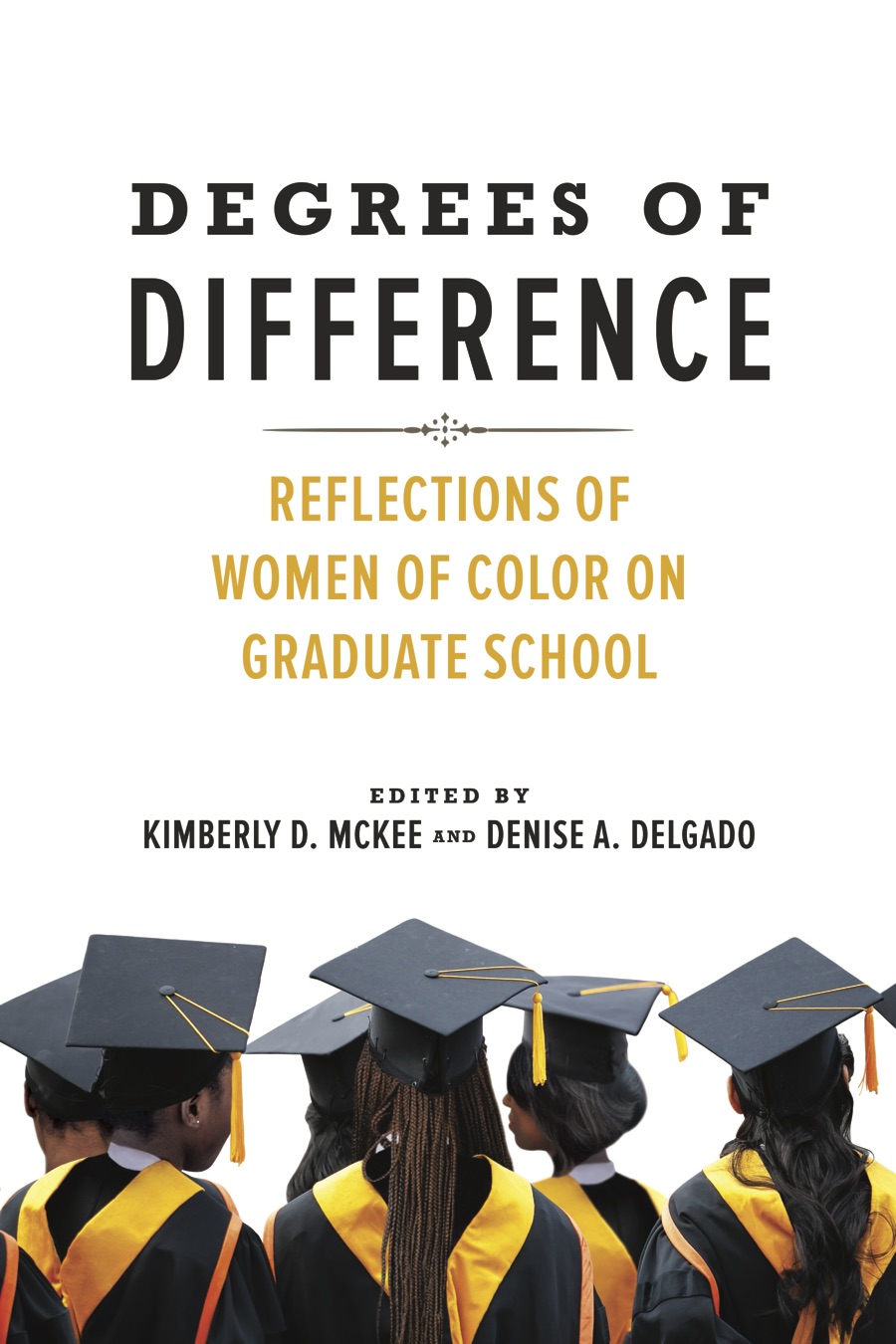
I also am the co-editor of Degrees of Difference: Reflections of Women of Color in Graduate School (University of Illinois Press, 2020), with Denise Delgado. Featuring the voices of nine women of color, Degrees of Difference offers strategies for self-care and what it means to build intentional and supportive communities to succeed, while also reflecting on what it takes to resist racism and unsupportive faculty and colleagues. The edited collection was recognized as a Choice Outstanding Academic Title 2020: Diversity, Equity, and Inclusion.
 Kimberly McKee, PhD